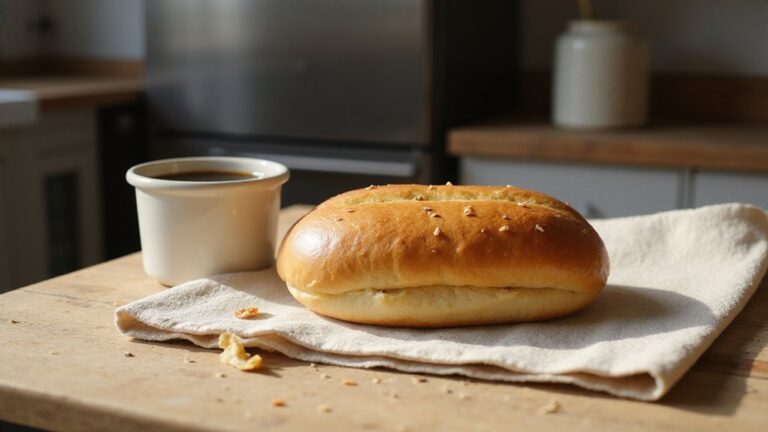

How Are Hot Dog Buns Cut? Inside the Process
Ever wonder how hot dog buns get that perfect split? It’s not just a simple cut with a knife—industrial machines carefully slice along a natural weak point formed during baking.
The method—top-split or side-split—keeps the bun sturdy and ready for fillings. Read on to see how precise technology makes these buns perfect every time.
Why Hot Dog Buns Don’t Just Get Sliced in Half?
Because hot dog buns are shaped differently from standard loaves, slicing them straight in half would compromise their structure and waste their best features. Unlike regular bread, the rounded top and flat bottom create an uneven cross-section, meaning a simple straight cut would result in a less functional and less appealing bun. Bakers intentionally develop a natural weak point along the side of the bun by using specific baking techniques, which allows for a controlled slit. This method preserves the integrity of the bun, keeping it sturdy enough to hold fillings without falling apart. It also creates a pocket that traps juices and condiments, enhancing flavor infusion. Instead of splitting into two separate halves, the bun remains an open cradle, designed to support your hot dog comfortably and deliver maximum flavor with minimal waste. For uniform slicing, a custom cutting board with stoppers prevents the blade from cutting too deep. Commercial bakers often rely on specialized freezing equipment to maintain bun freshness before packaging. Similar to how soft pretzels are given a baking soda bath to develop their signature chewy crust and golden color, bakers use precise techniques to produce the ideal texture and structure for each product. This careful engineering ensures that the bun’s value and performance match the quality and value of top popcorn seasonings, both designed to enhance the eating experience.
Two Cut Styles: Side-Split vs. Top-Split
The top-split style is generally more durable and better at preserving freshness compared to the side-split. Top-split buns are cut down the crown, creating a flat-bottomed pocket that holds the hot dog securely. This design reduces the risk of the bun tearing under heavy toppings and makes it easier to load up without everything falling apart. Additionally, the top opening exposes less surface area to air, helping to keep the bun fresher for longer. However, to prevent moisture loss and maintain quality, it helps to understand how freezer burn can affect any bread product stored improperly. For the most consistent results, using a dedicated popcorn maker can help you avoid similar storage issues by ensuring even heat distribution. For those seeking a reliable snack pairing, a review of top popcorn bags can guide you toward packaging that preserves crispness similar to a well-protected bun.
In contrast, side-split buns open from the side like a pocket, which makes inserting the hot dog straightforward. However, they tend to be less stable when loaded with toppings, as the side opening might not hold everything firmly. Side-split buns are often more flexible in shape and more common across the U.S., but they may not last as long or stay as crisp as top-split buns under heavy use.
How Industrial Machines Cut Hundreds of Buns Per Minute
Industrial machines can cut hundreds of buns per minute, with some systems reaching speeds of up to 400 buns. This high throughput makes manual slicing or house-made methods impractical for large-scale operations. The machines use continuous-feed belts and blade types such as disc or band blades for fast, efficient cutting. For consistent results, operators must ensure the proper ingredient ratios are maintained in the machine’s cooling system, similar to how a slushie machine requires exact measurements of syrup and water. This principle of precise mixture control also applies when preparing a DIY chafing dish fuel mixture, where the correct ratios of alcohol and gel ensure steady heat output. Adjustable guides and feed height ensure buns stay aligned before the cut, while sensor-controlled steps coordinate blade action with dough movement. Disc blades are ideal for hinge cuts or side splits, whereas horizontal band blades handle straight-through slices for maximum speed. These systems are designed for continuous operation, constantly feeding buns without interruption. Stainless steel frames facilitate easy cleaning, critical for bakery environments. Whether you need butterfly, wedge, or double butterfly cuts, these machines can switch configurations quickly. This flexibility helps keep your production line moving without losing time for adjustments, maintaining high efficiency in large-scale bun processing. Understanding the kernel count per cup helps operators estimate throughput when adapting machines for different baked goods.
What Keeps Hot Dog Buns From Falling Apart After Cutting?
Keeping hot dog buns from falling apart after cutting depends largely on controlling moisture, your cutting technique, and the bun’s construction. By maintaining the right moisture level, you prevent the interior from becoming brittle and prone to crumbling. A sharp, precise blade that stops just short of slicing through the base creates a hinge, allowing the bun to open like a book without tearing apart. Additionally, baking the buns in connected rows helps keep their shape uniform and reduces weak spots that might give way. A symmetrical, mirrored cutting pattern from alternating circular saw blades ensures connection while cutting, with the back sides of buns kept together and specific outer and inner connection points maintaining structural integrity. Combining careful moisture management, precise cutting, and a consistent baking format ensures the bun stays intact and easy to fill.
How Cutting and Packaging Happen in One Seamless Line
The slicing and packaging process occurs in one seamless flow, with no manual handling needed between steps. Automated conveyors carry buns directly from cooling to inspection and then straight into the packaging lane. Automatic feeders work in sync with slicing heads, aligning buns into rows of 6, 8, 10, or 20 before cutting. The system dynamically adjusts cut depth and slice thickness based on your bun type—whether fully through, hinge-sliced, or partially split. Indexing equipment positions each bun precisely so blades consistently hit the right spot every time. Inline quality control ensures the cuts are uniform before the sliced buns move onward to bagging or flow-pack machines. Connected flights transfer the product directly from the slicer to the packaging equipment, maintaining a continuous flow. Achieving crispy, uniform results requires the same precision as deep fryer baskets ensuring consistent heat distribution. The result is a high-throughput process with minimal interruption, from cooling to the final pack-out.
Why Factory Machines Beat a Knife for Precision
Factory machines deliver consistent precision because they are calibrated to open buns cleanly every time. Sensors detect each bun’s size and position, guiding fixed blades to align perfectly. The controlled height and depth of the blades create hinge-like cuts that avoid tearing, unlike manual slicing which can be uneven and apply inconsistent pressure. This automation ensures every bun is opened uniformly, without variances or crooked lines.
Automatic adjustments accommodate different bun sizes, maintaining the same cut quality regardless of variation. High-speed slicers can process over 7,000 buns per hour while preserving consistency. In contrast, using a knife limits you to about 6,000 pieces per hour because manual pressure can crush or unevenly cut the bread. Factory machines eliminate these flaws, giving you perfect, intact buns every single time.