Popcorn Kernels Nutrition Facts: Calories, Carbs & More
Ever wonder how many calories and carbs are in dry popcorn kernels?
You might assume popping changes everything, but it actually doesn’t—except for volume. Knowing these numbers can help you enjoy popcorn while staying mindful of your intake.
Keep reading to see how a small amount can fit into your snack plan without surprises.
Popcorn Kernel Calories: What You Need to Know Per Serving
A quarter-cup of dry popcorn kernels contains about 181 calories. This amount of kernels is roughly 4 tablespoons or 1 ounce. The calorie density remains the same regardless of popping method because popping only increases the volume, not the total energy. For example, two tablespoons of kernels provide around 110 calories, so the calorie count is proportional to the amount used. After popping, the popcorn expands significantly, but the calories stay the same. Air-popped popcorn, for instance, averages about 31 calories per cup, making it a lighter option when eaten in larger portions. Keep in mind, measuring your kernels before popping helps manage calorie intake, since the raw kernels contain the majority of the calories. Properly maintaining your equipment helps ensure even heat distribution, much like safe commercial deep fryer cleaning keeps those tools running longer. For consistently great results, selecting Top Popcorn Picks for Your Popcorn Maker ensures a reliable and enjoyable snack. For flavorful results, consider choosing high-quality popcorn kernels that pop evenly and produce a satisfying texture.
Total vs. Net Carbs in Popcorn: What’s the Real Carb Count?
When you look at the carb count for popcorn, the key numbers are total carbs and net carbs. Total carbs include all digestible carbohydrates, while net carbs subtract fiber, which your body doesn’t digest. For plain air-popped popcorn, one cup contains about 6.2 grams of total carbs and around 5 grams of net carbs after subtracting approximately 1.2 grams of fiber. The way you prepare the popcorn makes a big difference; air-popping keeps the carbs lower, while oil-popping can slightly increase the total carbs. Flavored popcorn, such as kettle corn or caramel-coated versions, significantly raises the net carbs to about 8 to 11 grams per cup. Portion size is crucial—three cups of air-popped popcorn provide roughly 14 grams of net carbs. Even healthy-looking portions can add up fast if you indulge beyond moderation, so sticking with plain air-popped popcorn helps keep your carb count honest. Proper storage in a freezer prevents kernels from losing moisture and yielding fewer popped cups. If you want to avoid stovetop oil altogether, microwave popcorn makers offer a convenient way to air-pop kernels without added fats. For a refreshing low-carb alternative, consider using a slushie machine to blend crushed ice with sugar-free syrups.
Why Popcorn Kernels’ Fiber Makes Them a Smart Snack
Because popcorn kernels are whole grains that retain the bran, germ, and endosperm, they provide a substantial fiber boost that refined snacks lack. Air-popped popcorn offers about 1.2 grams of fiber per cup; a three-cup serving thus supplies roughly 3.6 grams, covering nearly 15% of your daily fiber needs for fewer than 100 calories. This fiber adds bulk, helping you feel full longer and supporting your metabolism without causing sharp blood sugar spikes like processed crackers do. The insoluble fiber found in popcorn also encourages regular bowel movements, aiding digestion and keeping your digestive tract moving smoothly. Plain popcorn surpasses chips and rice cakes in fiber content, but coating it with sugar or butter quickly diminishes this advantage. For the best results, choose a quality popcorn maker to ensure even heating and maximum kernel pop rate, as top-rated models often achieve a higher pop rate for less waste. For a punch of flavor without undermining these benefits, consider adding dill pickle seasoning to your air-popped kernels. For the smartest snack, stick to air-popped popcorn without added toppings.
Protein and Fat in Popcorn Kernels: What’s Inside?
Popcorn kernels naturally contain about 3 grams of protein and 1 gram of fat per ounce of unpopped kernels. Most of the fat is unsaturated, making it a heart-healthy option. These nutrients are inherent in each kernel, so you don’t need to add oil to benefit from them. However, once you pop the kernels with butter or oil, the fat content increases significantly. Despite this, plain popcorn remains low in fat and provides a good protein-to-fat ratio. Additionally, popcorn kernels contain antioxidants like polyphenols that survive processing, offering extra health benefits. Eating plain popcorn can support steady energy levels without extra calories, just be mindful of how you prepare it. For those who want to prepare large batches conveniently, investing in a popcorn machine with cart can help maintain the kernel’s nutritional profile by avoiding excess oil during popping. Starting a hot dog cart business requires initial capital for permits and equipment, which helps manage portion sizes and costs. Eating whole unpopped popcorn kernels is not recommended due to the risk of dental damage and choking.
Popcorn’s Key Micronutrients: Potassium, Magnesium, and Zinc
A one-ounce serving of air-popped popcorn provides about 93 mg of potassium, 41 mg of magnesium, and 0.9 mg of zinc. While popcorn isn’t a major source of these minerals, it still offers a modest boost. Magnesium is the most plentiful of the three, supporting your energy production and muscle function. Zinc, although present in smaller amounts, plays a crucial role in immune health. Potassium helps regulate fluid balance, but popcorn contributes only a minor amount. To maximize mineral retention, stick to plain, air-popped kernels without added salt or fats. This snack provides a small but meaningful mineral supplement, fitting into a balanced diet without overloading on sodium or fats. Unlike a steam table that uses hot water or steam to keep pre-cooked foods warm, this popcorn is prepared dry and retains its mineral content without added moisture or fat. For a convenient way to store and transport this healthy snack, consider using one of the best cotton candy bags designed to keep contents fresh and portable. However, note that the flavors of this dry snack are not altered by added syrups or liquids, similar to how shaved ice flavors are truly distinct only when made with pure, unadulterated syrups rather than generic mixes.
Why Serving Size Matters More Than You Think
Serving size can drastically change your calorie intake, often more than you realize. For example, popping a quarter cup of kernels delivers around 181 calories and 35.7 grams of carbs. That small measure, when popped, doubles or triples in volume, spreading into four or five cups—potentially misleading your view of how much you’re eating. Two tablespoons of unpopped popcorn—sometimes listed as a standard serving—are only about 110 calories but expand into a much larger amount once popped. Different brands also vary in their serving sizes; one may suggest three tablespoons (around 120 calories), while another lists a quarter cup (about 181 calories). Checking gram weight rather than relying on bowl size is essential for accurate portion control. Plus, flavorings like butter and seasoning pack in extra calories, so added toppings make managing portions even more critical. Don’t let the volume of popped popcorn trick your calorie count. Choosing the right quality and value often requires the same careful attention to detail as comparing dry versus popped measures. For a low-calorie treat, air-popping kernels without oil is an easy homemade technique that avoids extra fat.
How to Measure and Prepare Popcorn Kernels Without Additives
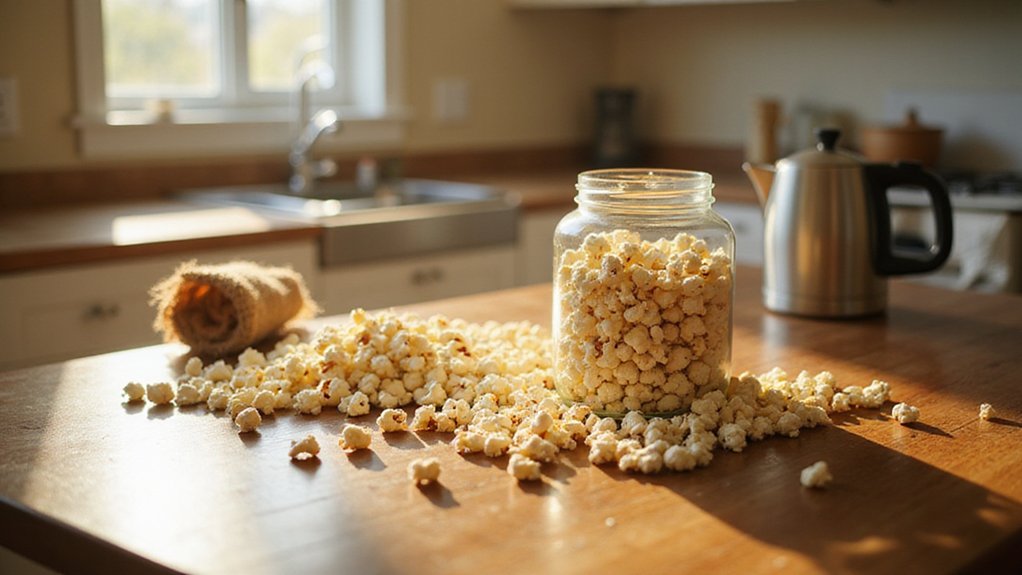
To measure popcorn kernels accurately before popping, stick to about ¼ cup for each batch. Using a standard measuring cup or your air-popper’s built-in cup—often the butter-melting cap—ensures consistent portions. Overfilling the chamber can jam the machine and reduce popping efficiency, so always follow the recommended amount. This precision helps you get evenly popped kernels without waste. For stovetop popping, heat a heavy pan with three test kernels first. When they pop, add ¼ to ⅓ cup of kernels, cover the pan, and shake frequently. Monitor the pops carefully: when you hear a 2 to 3 second pause between pops, remove the pan immediately to avoid scorching from residual heat. Transfer the popped popcorn straight to a bowl to stop any further cooking. This method yields clean, additive-free popcorn in about 4 to 5 minutes, with no oil or butter needed.